Linear Algebra for Deep Learning

From scalars to PCA · Chapter 2 + reproducible Google Colab labs

Juan Sebastian Laverde

2026-01-01

The question that guides the class

How does a computer turn numbers, images, and text into mathematical objects that an AI model can process?

Real-world data
Numbers
Tensors
Operations
AI model

Learning objectives

By the end, learners will be able to:

  1. Identify scalars, vectors, matrices, and tensors in real-world data.
  2. Interpret shape, ndim, batches, and channels.
  3. Understand why matrix multiplication appears in neural networks.
  4. Explain inverses, rank, norms, eigenvectors, SVD, and PCA intuitively.
  5. Reproduce each section from 2.1–2.12 in Google Colab.
  6. Move tensors among NumPy, TensorFlow, and PyTorch, including CPU/GPU.

Three-hour roadmap

45 min

2.1–2.4 · objects, products, inverse, span

35 min

2.5–2.7 · norms, special matrices, eigen

45 min

2.8–2.12 · SVD, pseudoinverse, trace, determinant, PCA

35 min

Colab · datasets + frameworks + CPU/GPU

+ 20 min spread across questions, transitions, and a short break.

2.1 Scalars, vectors, matrices, and tensors
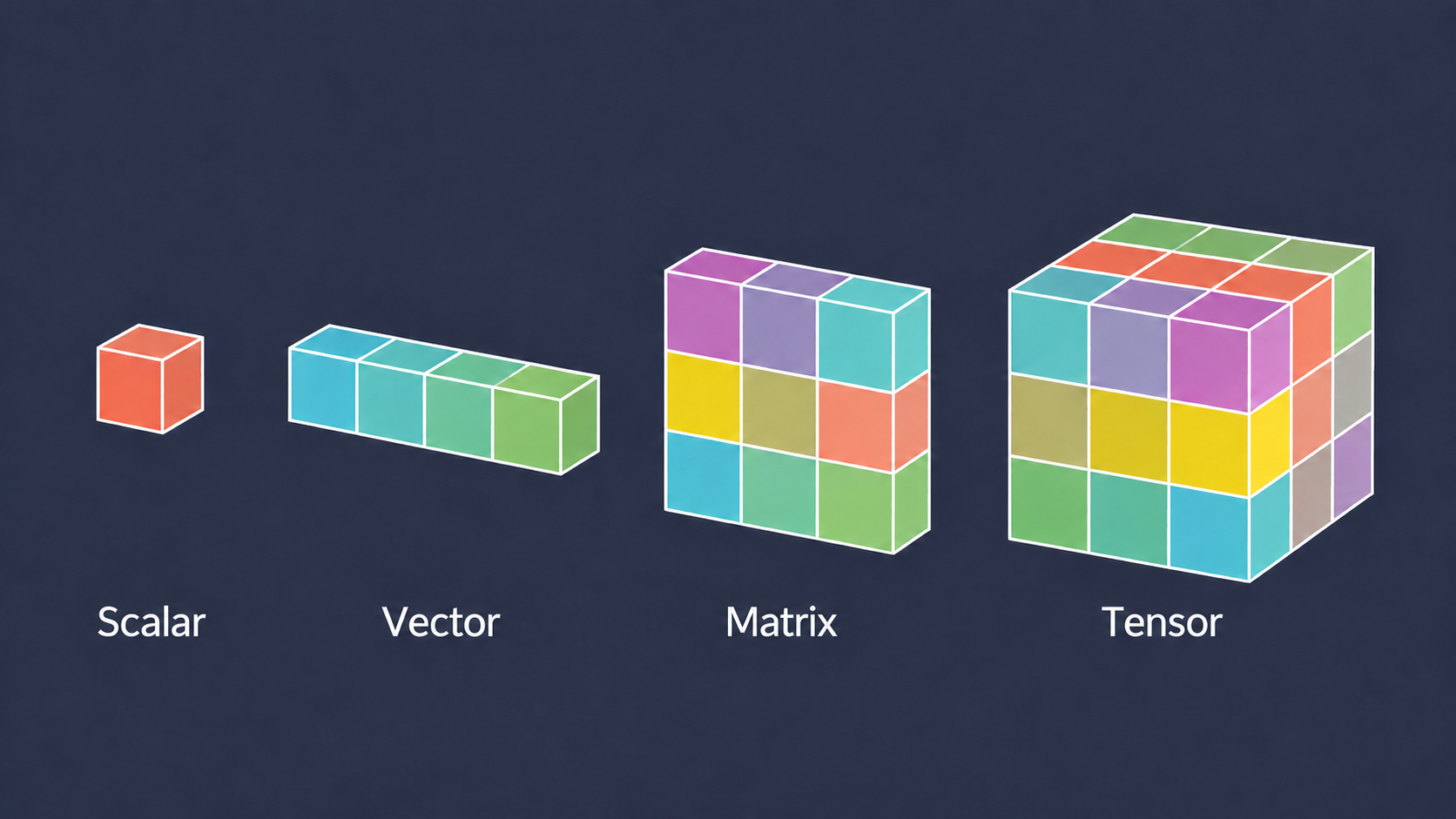
Scalars

Scalars

A scalar is the simplest form of data: a single numerical or symbolic value. It can represent a constant or a univariate variable.

In machine learning, we usually work with real-valued scalars:

\[ a \in \mathbb{R} \]

Represents a single value

It has no dimensions or direction

It can be real or complex

Although they seem simple, scalars are fundamental: many model hyperparameters, such as learning rate \(\lambda\), the number of epochs, or a threshold, are often expressed as scalar values.

5
🌡️
24°C
λ
= 0.01
x
= 3.5

A scalar = one value

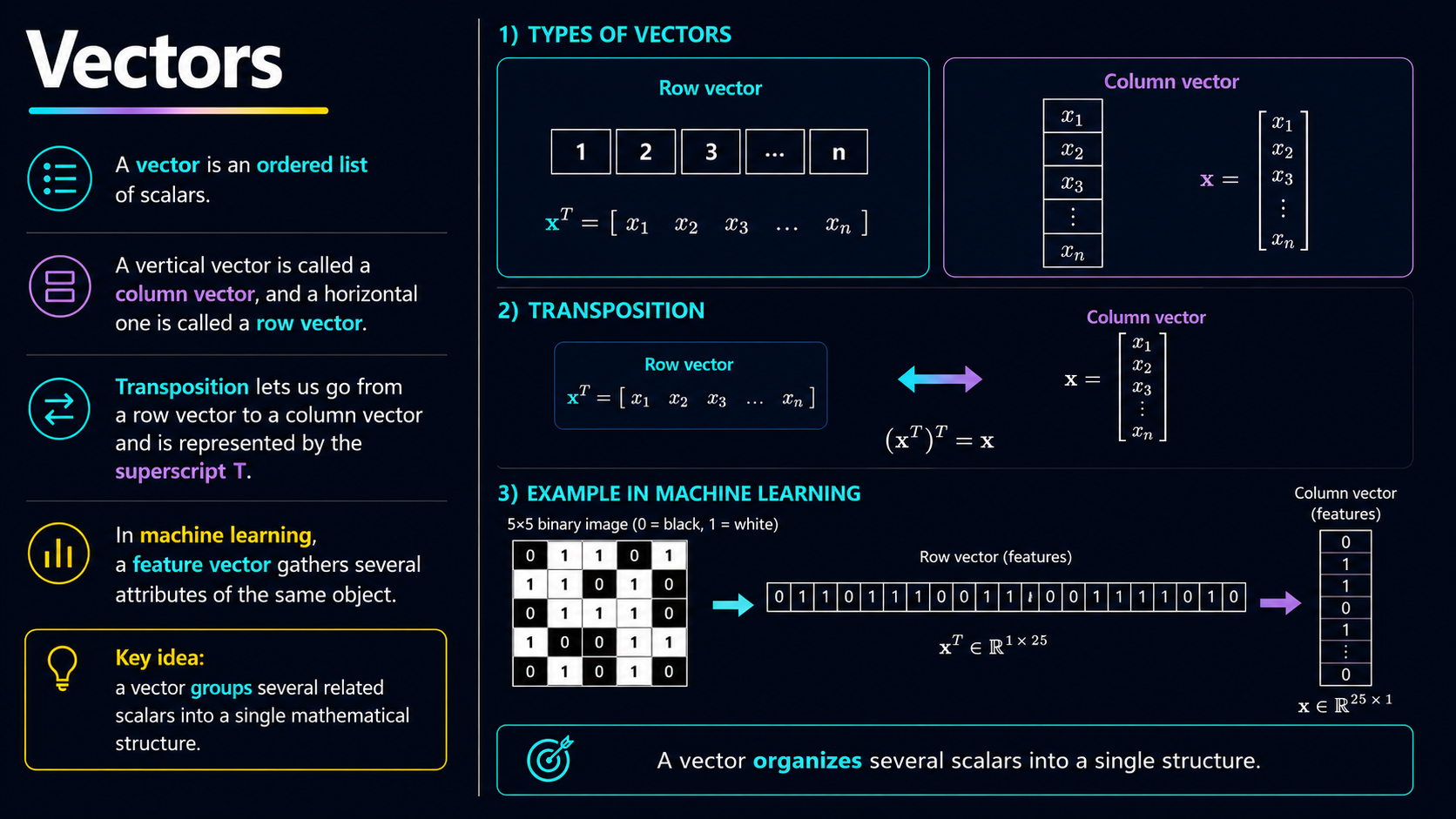
Vectors

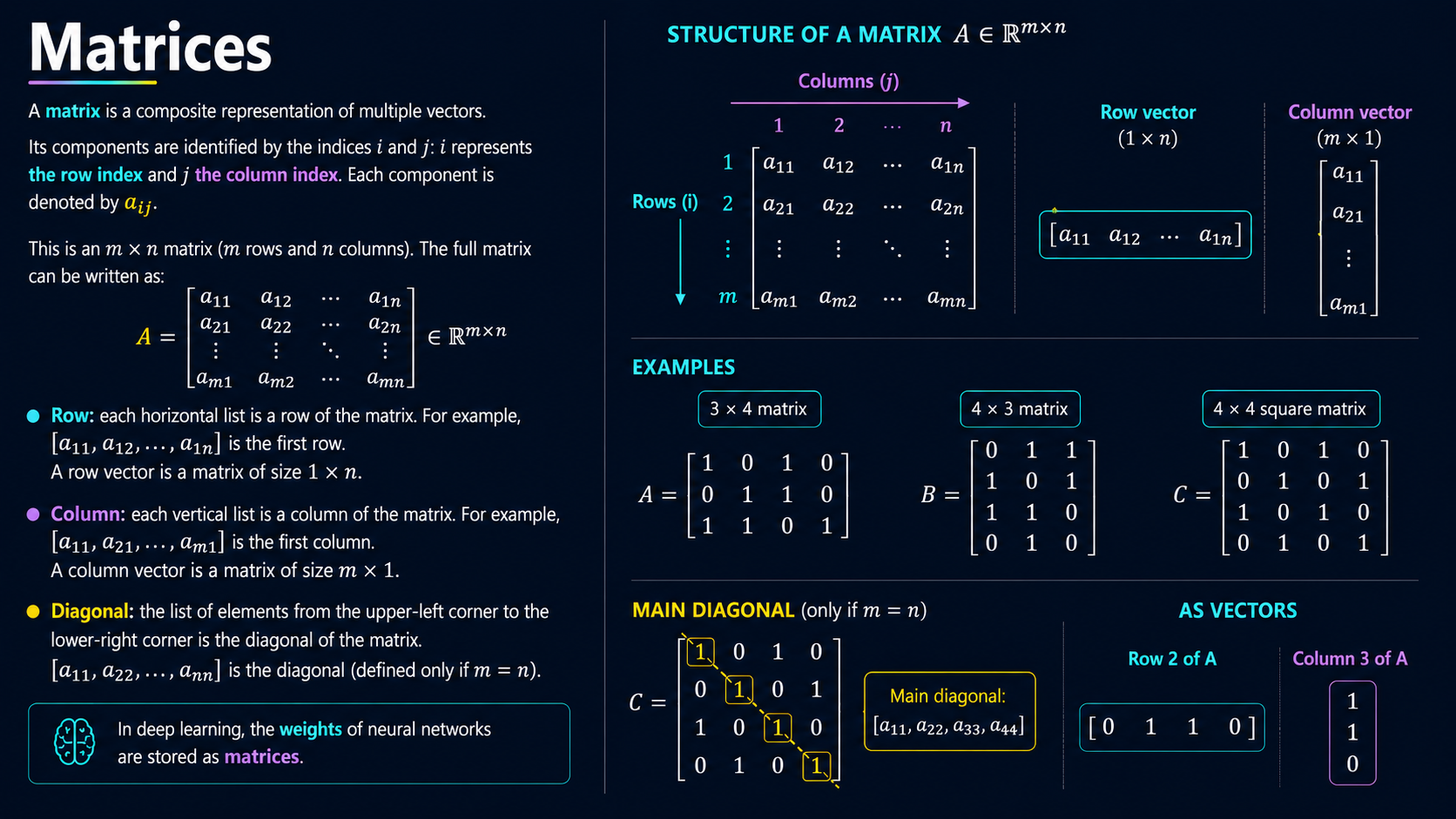
Matrices

Vectors

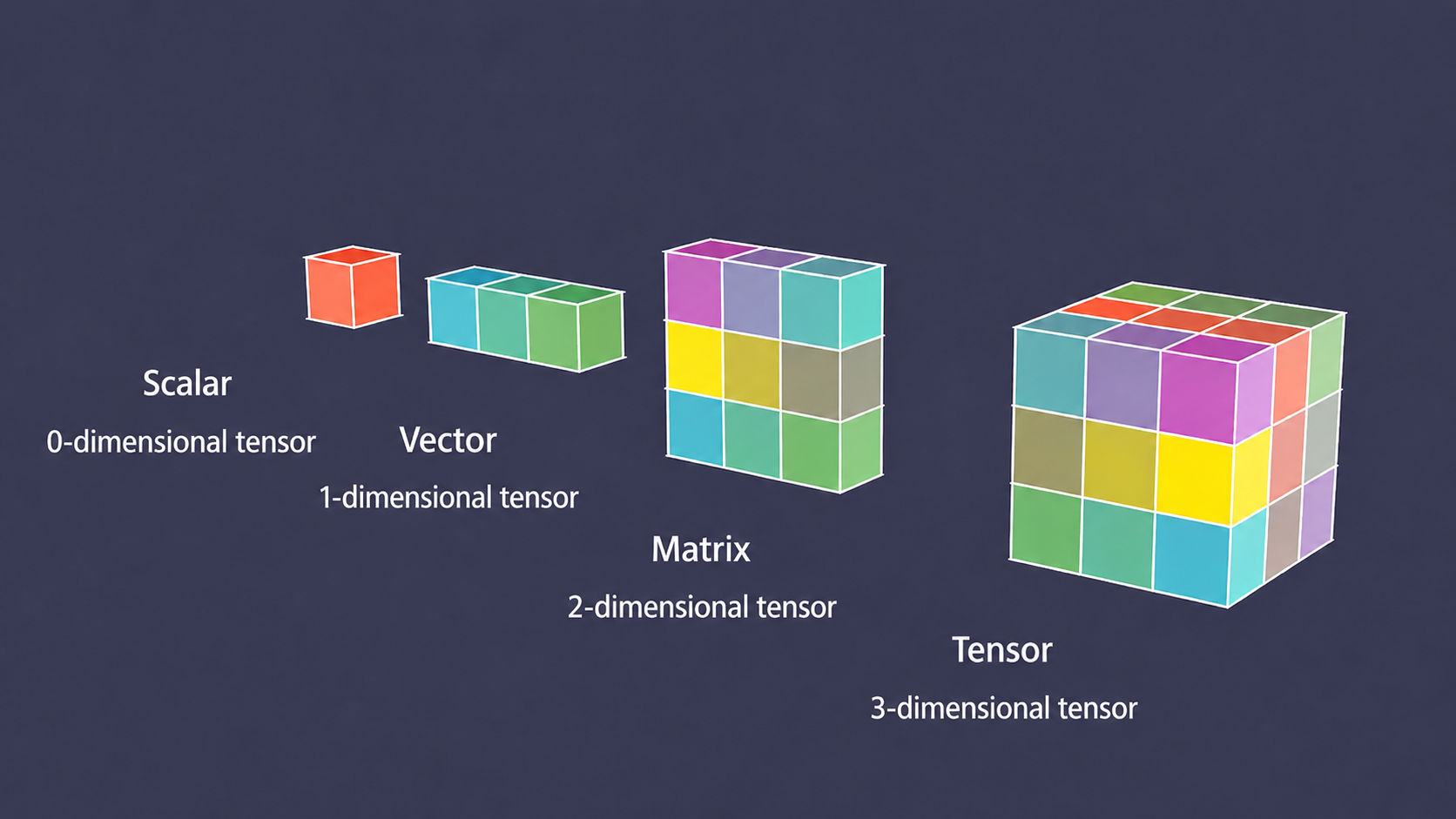
Four objects, one idea

Object Simple explanation Data example Typical shape Tensor dimension / rank
Scalar one number age () Tensor 0D
Vector ordered list one person (4,) Tensor 1D
Matrix 2D table 100 people × 4 variables (100, 4) Tensor 2D
Tensor 3D array with 3 axes RGB image (224, 224, 3) Tensor 3D
Tensor 4D array with 4 axes batch of RGB images (32, 224, 224, 3) Tensor 4D
Tensor 5D array with 5 axes batch of videos (8, 30, 224, 224, 3) Tensor 5D
Tensor 6D array with 6 axes batch of video sequences (4, 10, 30, 224, 224, 3) Tensor 6D

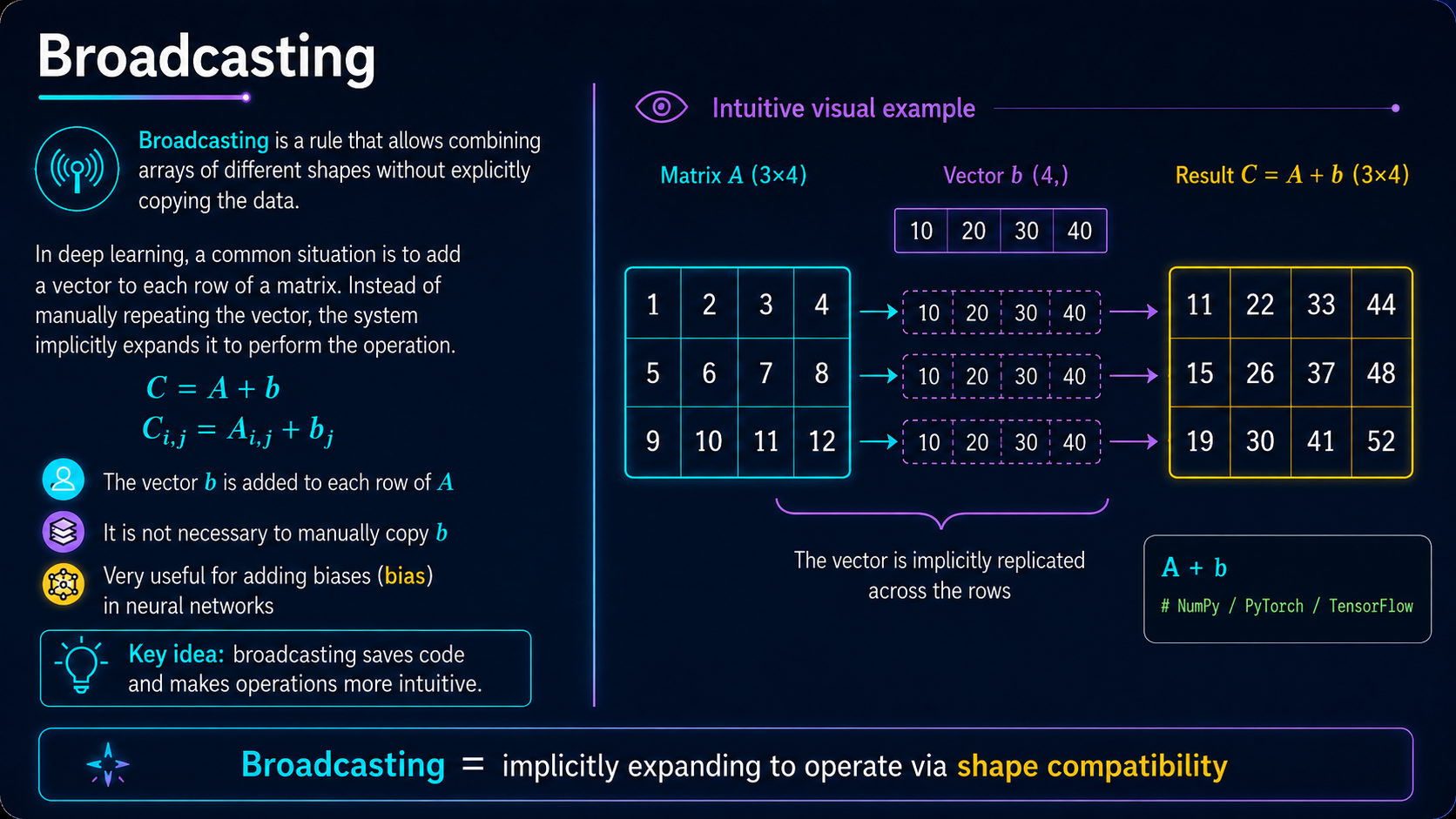
Broadcasting

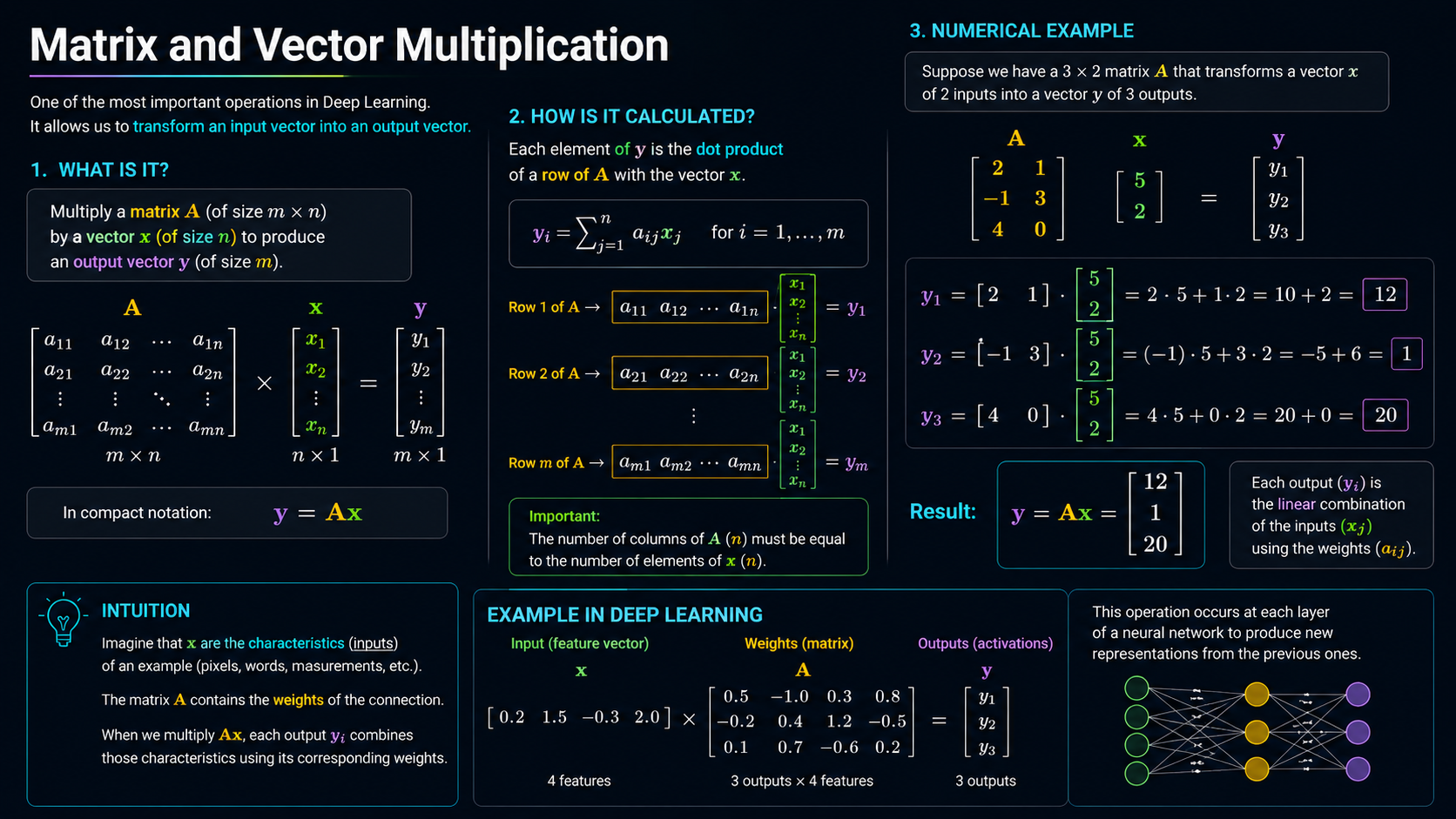
2.2 Matrix and Vector Multiplication
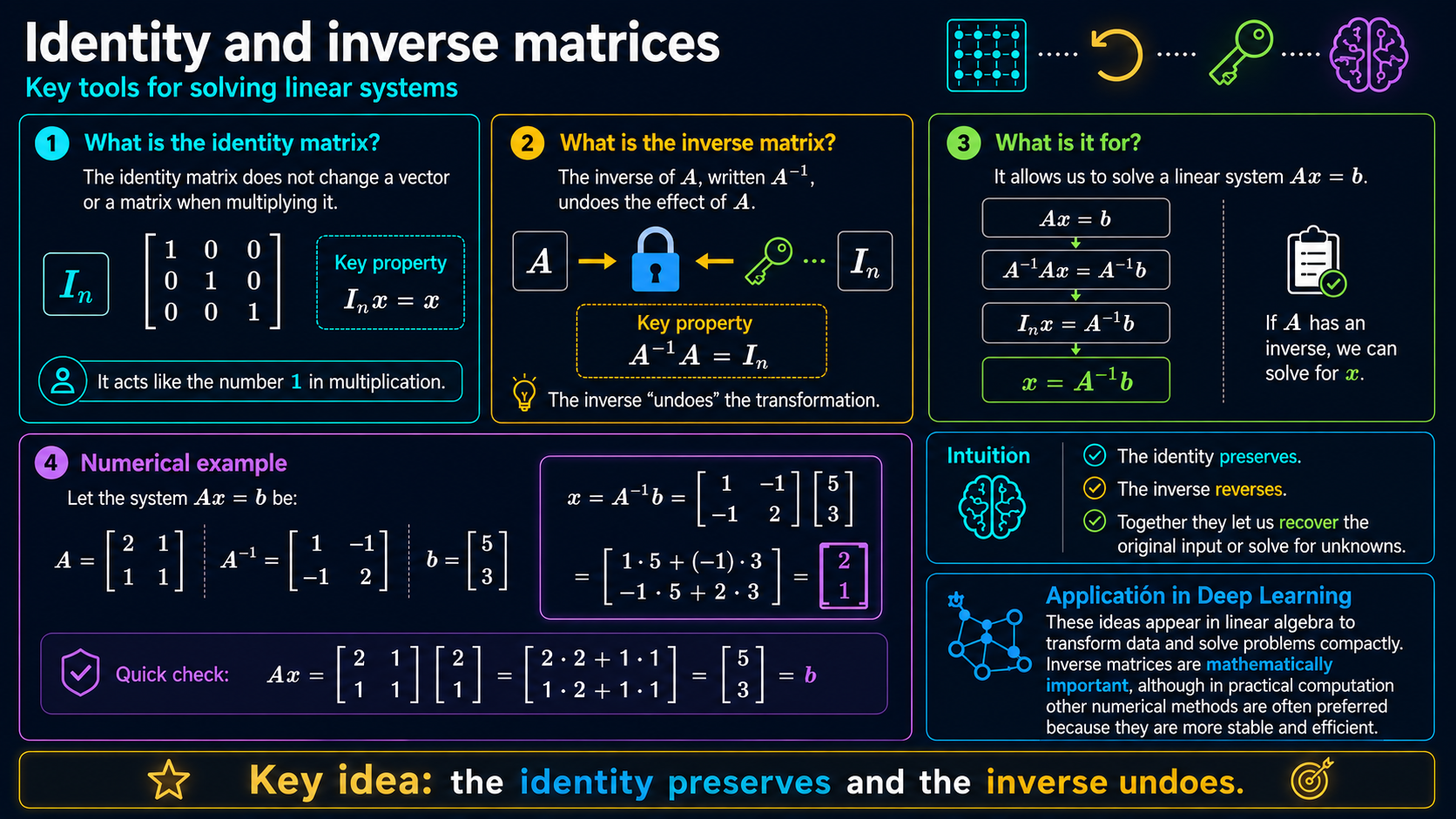
2.3 Identity and Inverse Matrices
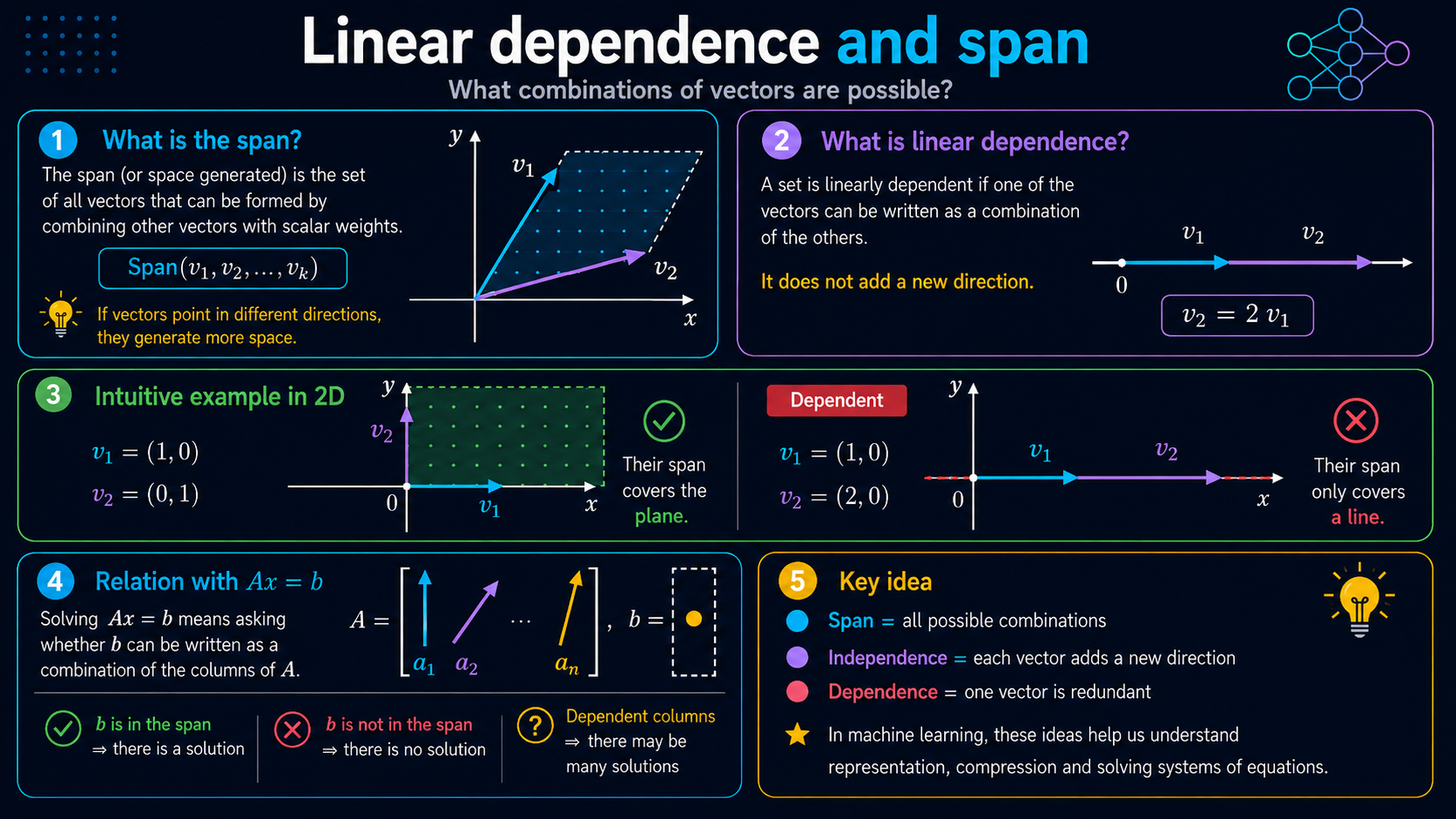
2.4 Linear Dependence and Span
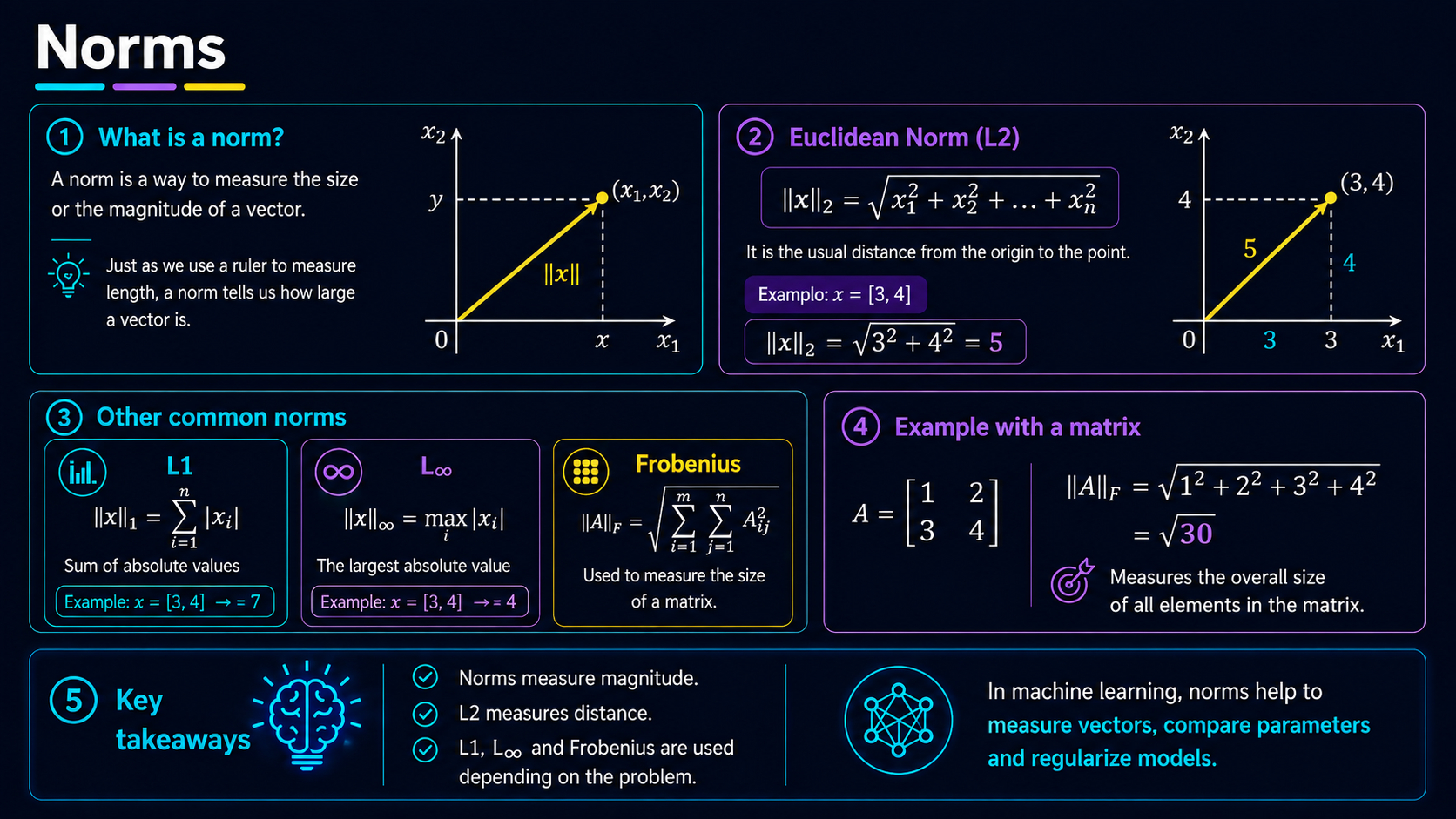
2.5 Norms
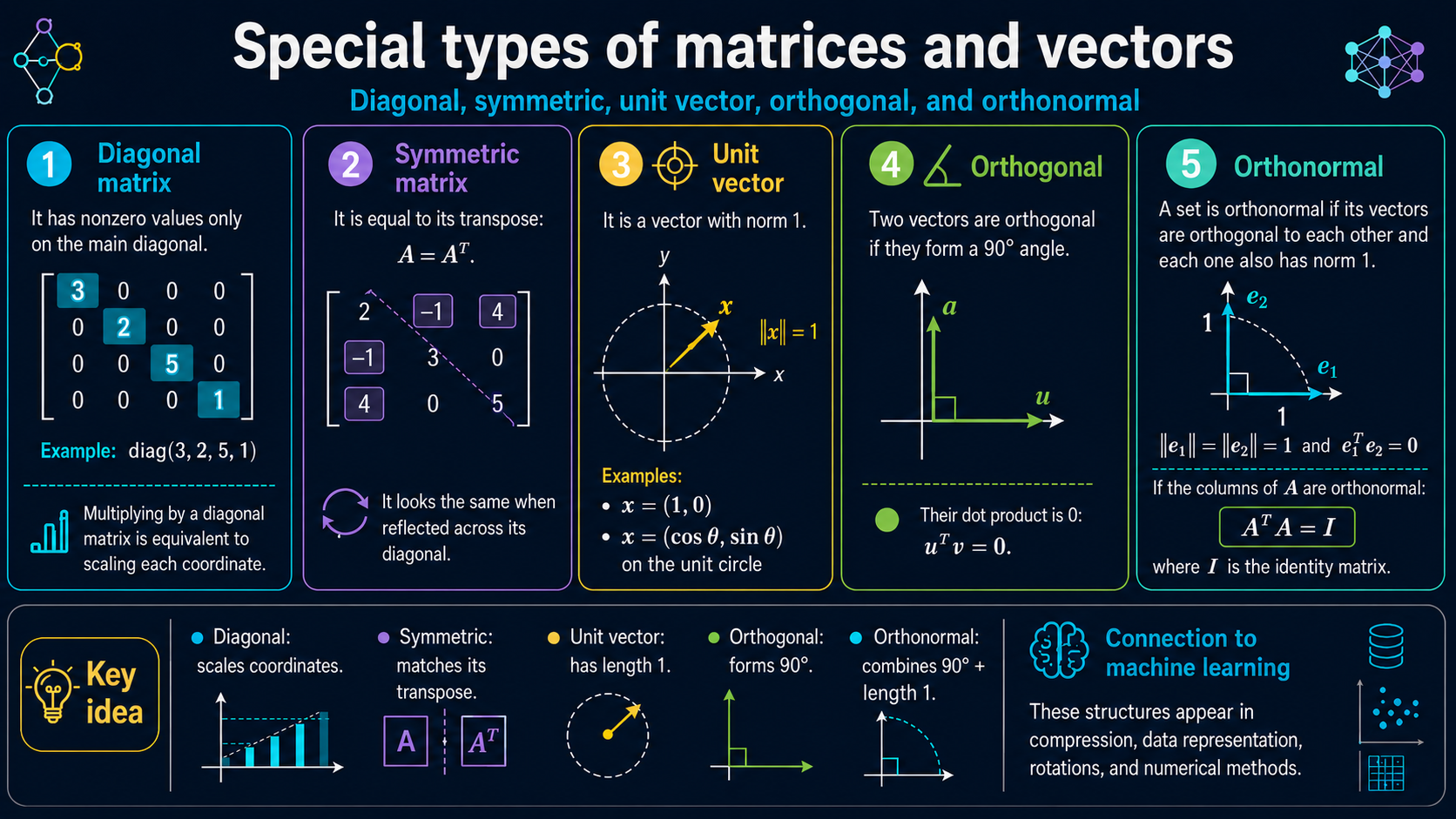
2.6 Special Types of Matrices and Vectors
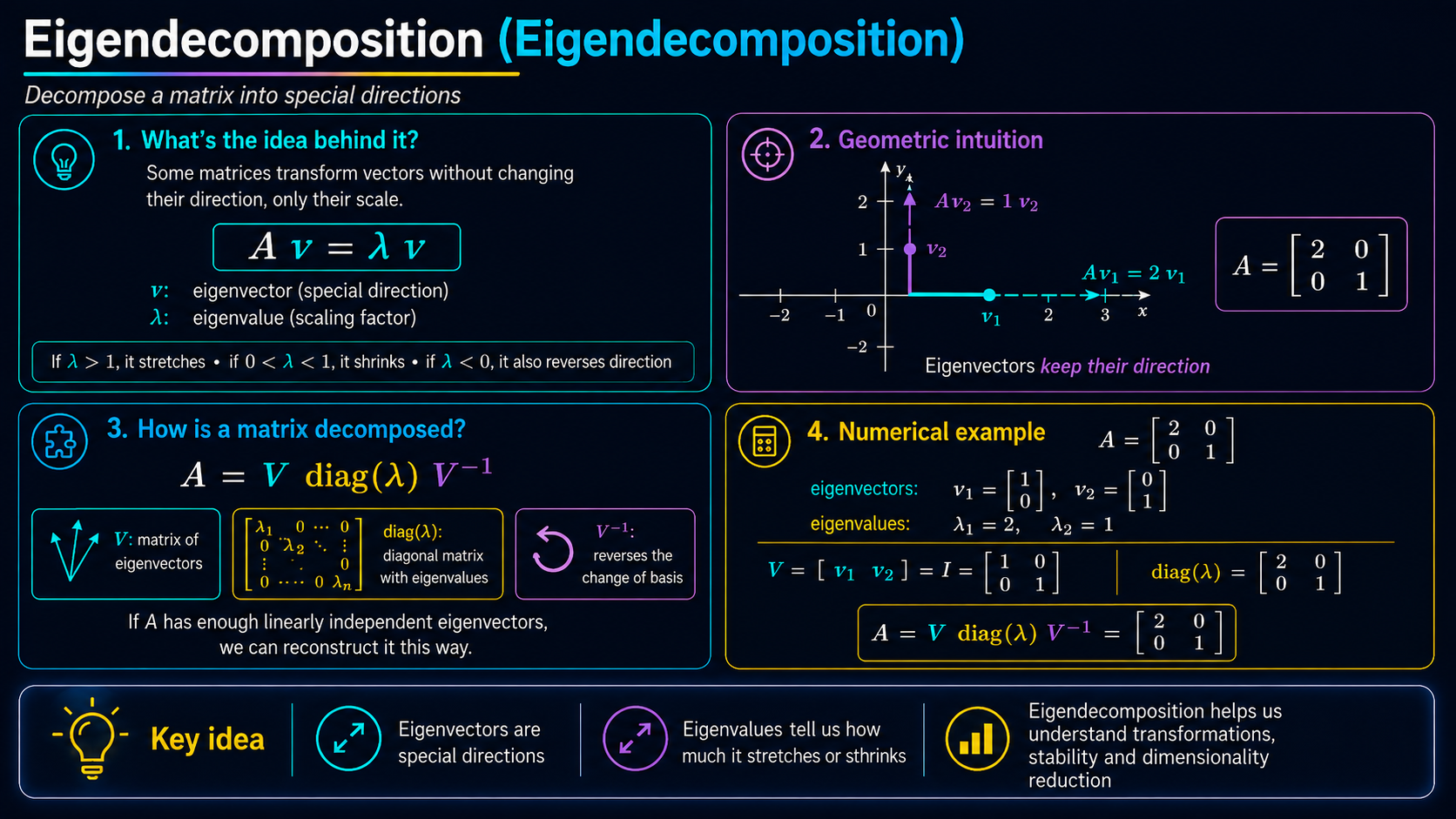
2.7 Eigendecomposition
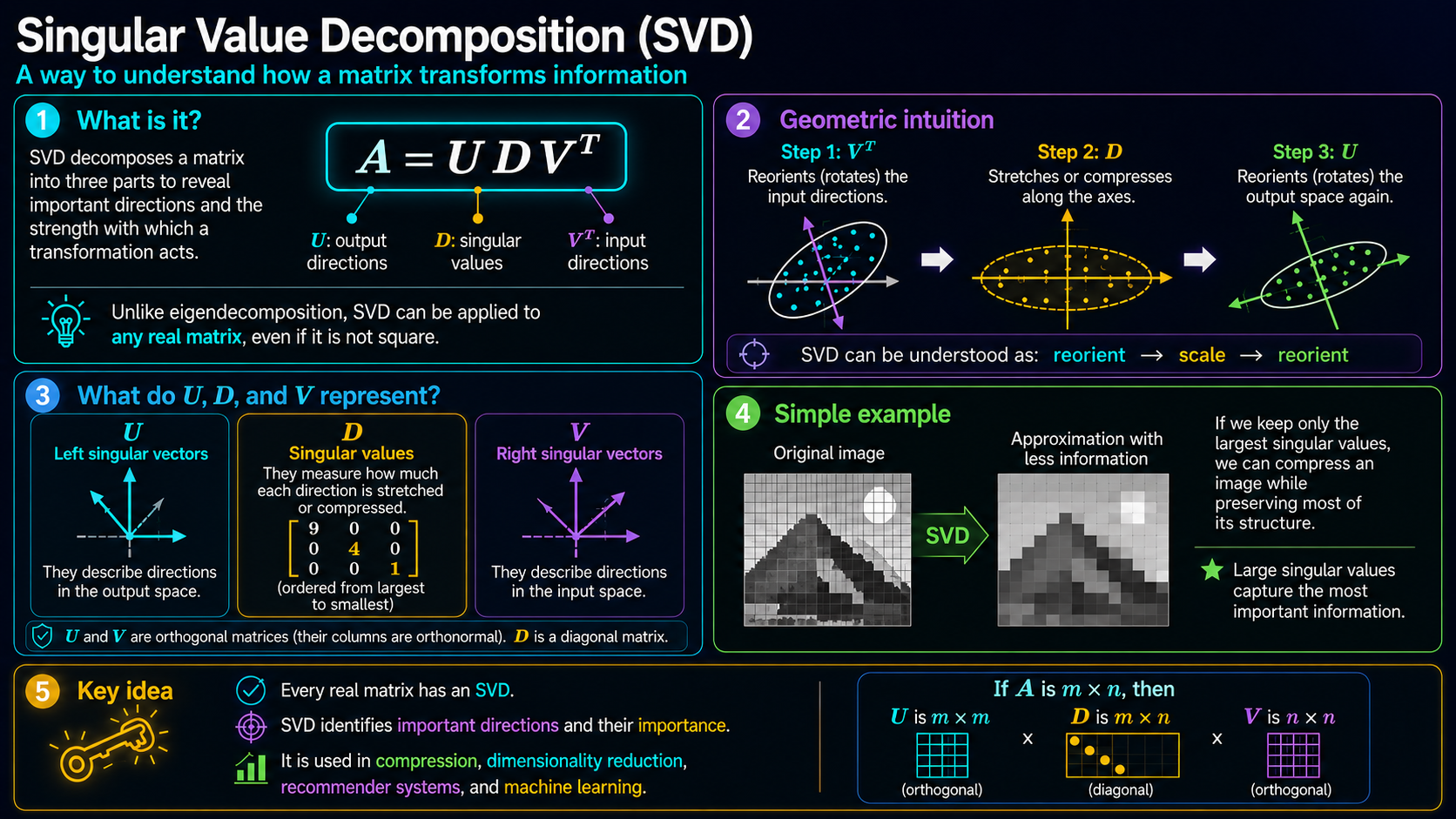
2.8 Singular Value Decomposition (SVD)
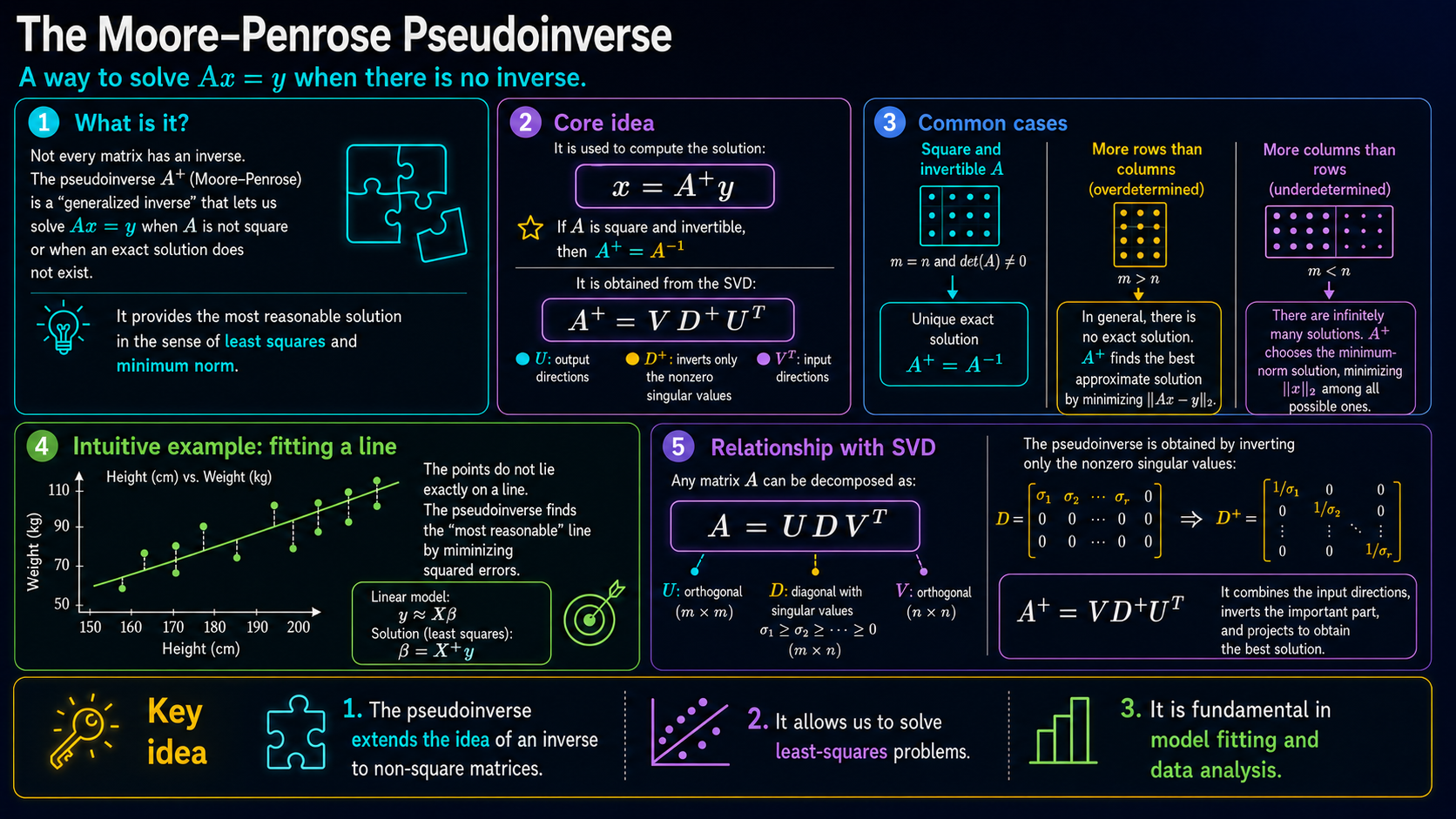
2.9 Moore–Penrose Pseudoinverse
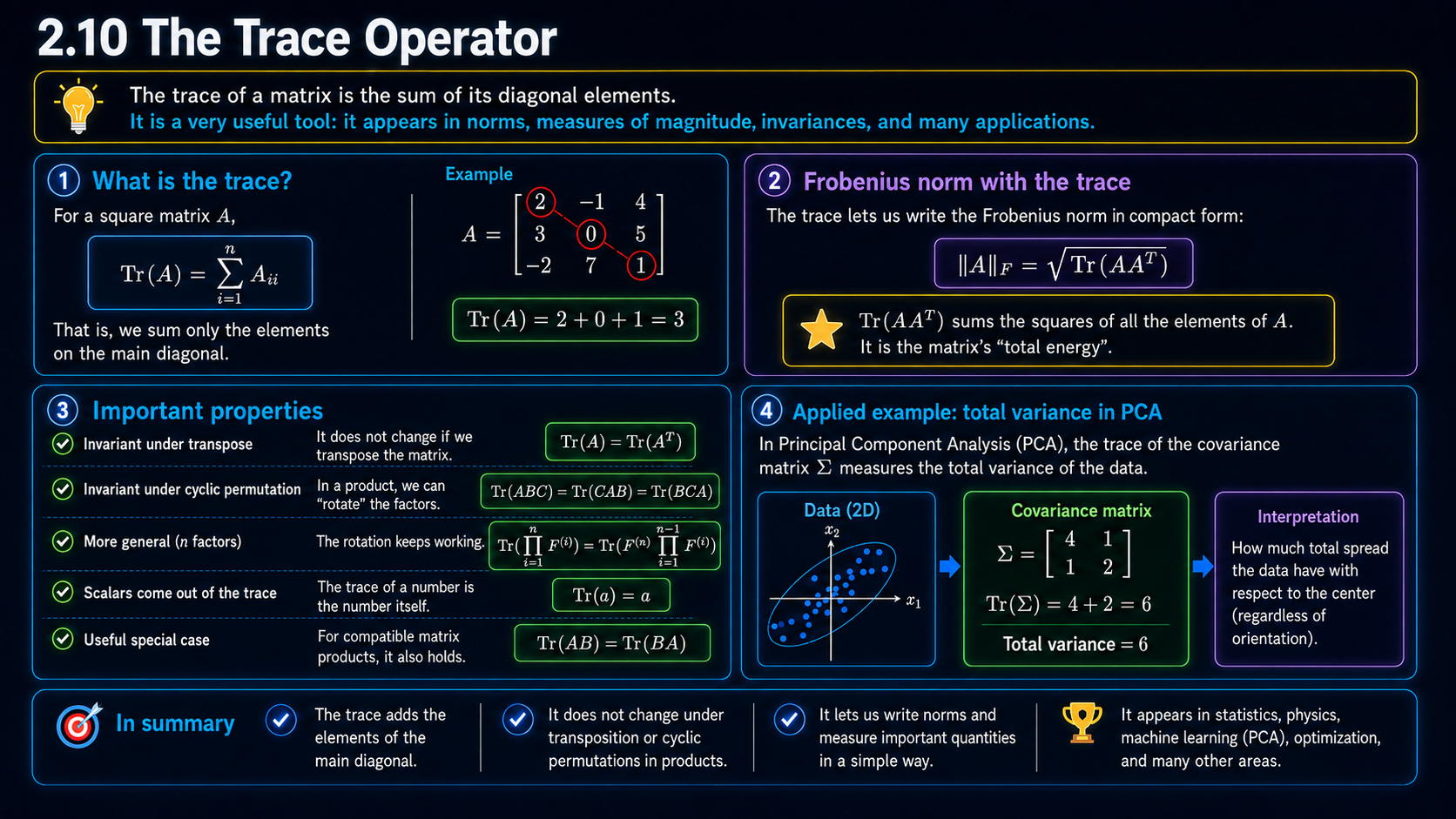
2.10 The Trace Operator
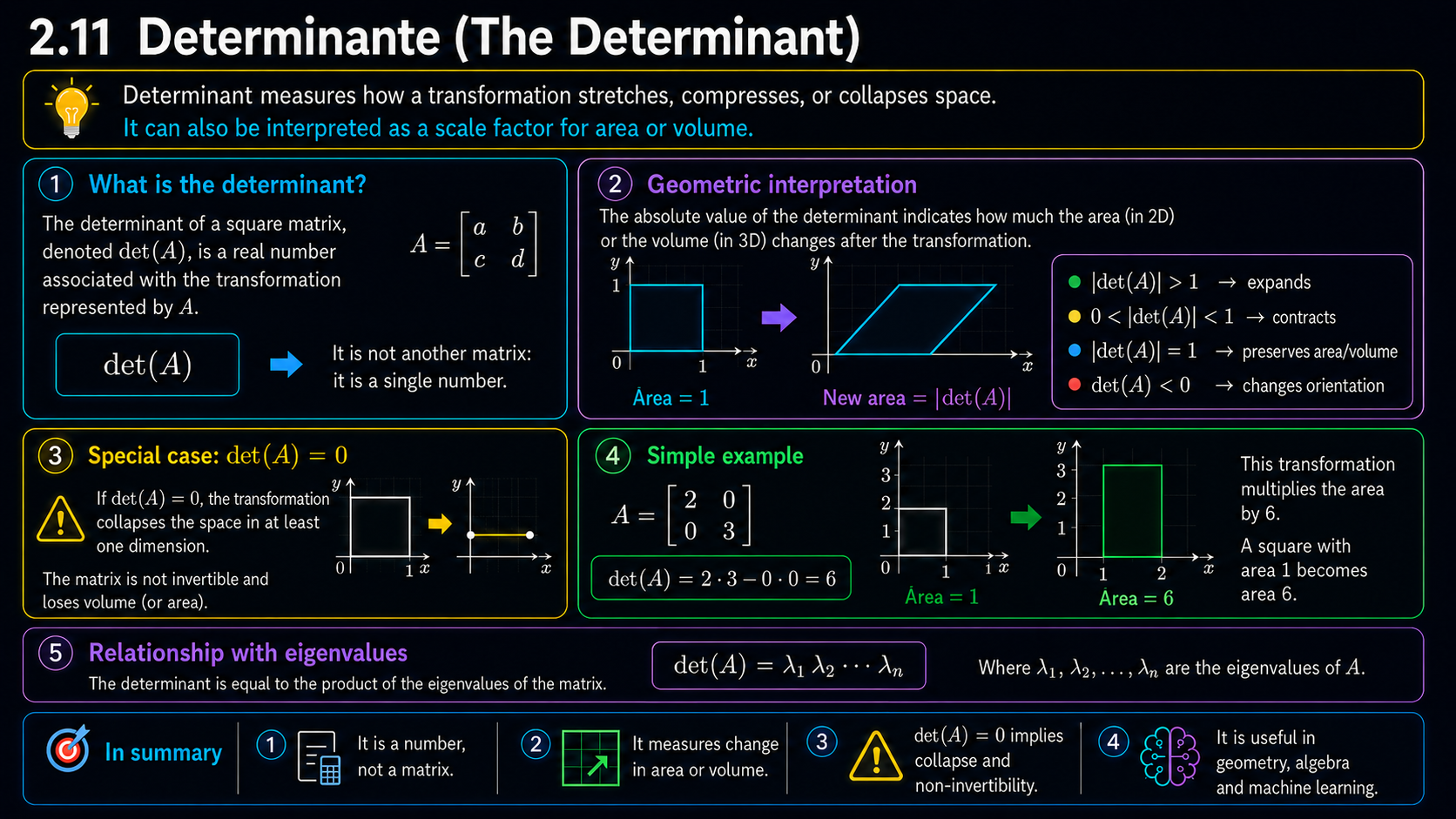
2.11 Determinant
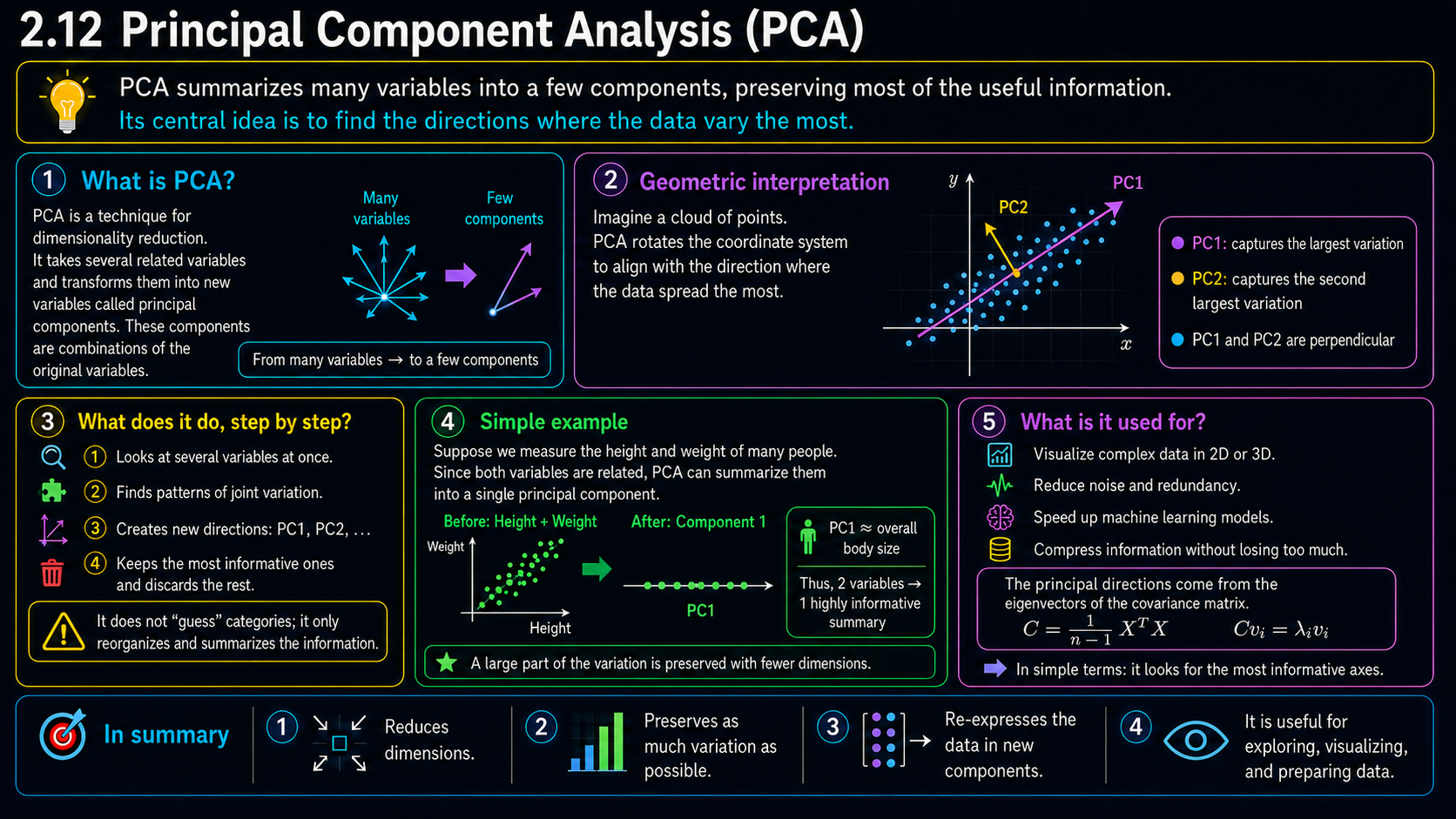
2.12 Example: Principal Components Analysis (PCA)
The algebra stays the same; where it runs changes

               same operation
                    A @ B
                      │
        ┌─────────────┼─────────────┐
        ↓             ↓             ↓
      NumPy      TensorFlow      PyTorch
       CPU        CPU / GPU       CPU / GPU

Repository and labs

Structure prepared for GitHub Pages:

linear-algebra-deep-learning/
├── en/
│   ├── slides/
│   └── exercises/
├── es/
│   ├── slides/
│   └── exercises/
├── shared/
├── _quarto.yml
└── .github/workflows/publish.yml

Expected URL:

https://laverde97.github.io/linear-algebra-deep-learning/

Sources and credits

  • Goodfellow, I., Bengio, Y. & Courville, A. Deep Learning, Chapter 2: Linear Algebra. MIT Press (Goodfellow et al. 2016). https://www.deeplearningbook.org/contents/linear_algebra.html
  • Quarto RevealJS documentation: https://quarto.org/docs/presentations/revealjs/
  • Quarto GitHub Pages publishing: https://quarto.org/docs/publishing/github-pages.html
  • MNIST via TensorFlow/Keras (LeCun et al. 1998).
  • IMDB Reviews via TensorFlow/Keras (Maas et al. 2011).
  • ImageNet-v2 documentation via TensorFlow Datasets (Recht et al. 2019); for the live class the notebook uses a lightweight ImageNet-format demonstration and leaves ImageNet-v2 as optional due to download size.
Original teaching content based on the chapter concepts; it does not reproduce the full text of the book.

Key takeaway

Deep learning works with representations. Linear algebra gives us the language to describe, transform, measure, and compress them.

Understand
Run
Visualize
Connect to AI
Goodfellow, Ian, Yoshua Bengio, and Aaron Courville. 2016. Deep Learning. MIT Press. https://www.deeplearningbook.org/.
LeCun, Yann, Leon Bottou, Yoshua Bengio, and Patrick Haffner. 1998. “Gradient-Based Learning Applied to Document Recognition.” Proceedings of the IEEE 86 (11): 2278–324.
Maas, Andrew L., Raymond E. Daly, Peter T. Pham, Dan Huang, Andrew Y. Ng, and Christopher Potts. 2011. “Learning Word Vectors for Sentiment Analysis.” Proceedings of ACL.
Recht, Benjamin, Rebecca Roelofs, Ludwig Schmidt, and Vaishaal Shankar. 2019. “Do ImageNet Classifiers Generalize to ImageNet?” International Conference on Machine Learning.